A reseller finds a promising SMM panel. The website advertises direct provider rates, thousands of services, API access, and immediate order processing. Everything looks suitable until a customer places an order that remains pending for hours.
The reseller contacts support. The response is familiar: the issue has been forwarded to the provider.
That raises an obvious question. If the panel presents itself as the main provider, who is the provider it needs to contact?
This situation illustrates one of the confusing parts of the SMM industry. The expression main provider SMM panel appears on countless websites, but it doesn’t have a universally accepted technical definition. A business can describe itself as a primary supplier while purchasing some or all of its services from another company.
For someone buying an occasional service, the distinction might not seem especially relevant. For resellers, agencies, and businesses managing customer orders through an API, understanding the supplier structure can make a considerable difference.
A provider’s position in the supply chain influences how it handles order failures, updates its catalog, communicates service changes, and responds when an upstream connection stops working.
This guide examines what the term main provider actually means, how SMM service distribution works, and what buyers can reasonably verify before choosing a supplier.
It also explains why a direct supplier isn’t automatically the best choice for every service and how tools such as SMMCin can help with provider research without relying entirely on advertising claims.
What Is a Main Provider SMM Panel?
In the SMM industry, a main provider is generally understood to be a business that supplies social media services to other panels, resellers, or customers from a relatively upstream position in the distribution process.
That definition sounds simple enough.
The difficulty is determining exactly where a particular business sits.
Some providers maintain direct commercial relationships with service fulfillment operators. Others manage several supplier connections, combining services into one catalog. A third group purchases services from another panel and resells them, sometimes through an additional API layer.
All three businesses may offer the same customer-facing features.
They can display services, accept payments, assign order numbers, provide API credentials, and allow resellers to check order statuses.
From the outside, their websites may look nearly identical.
The difference becomes more apparent when something needs attention behind the scenes.
A supplier that directly manages a particular service may have greater control over capacity, pricing, interruptions, and fulfillment decisions. A reseller operating through another API must often depend on its upstream partner to resolve those problems.
However, direct control should not be confused with automatic reliability.
A company can manage its own fulfillment infrastructure and still experience operational problems. Another business may use external suppliers while maintaining effective support and sensible order-management procedures.
The term main provider describes a claimed position in the service supply chain. It doesn’t independently certify quality, ownership, or performance.
That distinction should guide the rest of your research.
How the SMM Panel Supply Chain Works
Consider a simplified service distribution model.
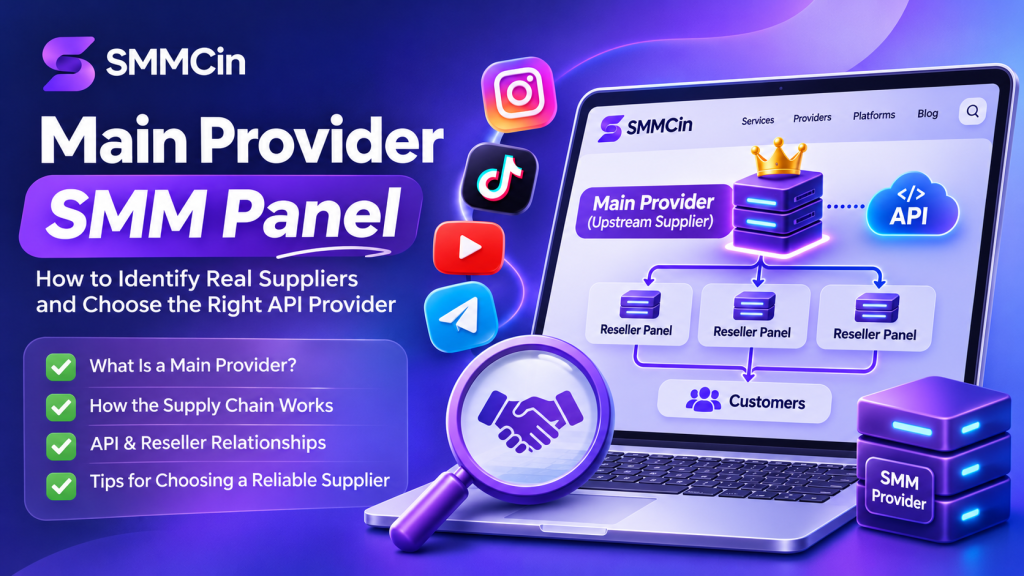
A fulfillment operator supplies a particular service to an upstream distributor. The distributor makes it available through an API. A reseller connects that API to its own panel and sells the service to customers.
The order may pass through several systems before reaching the party responsible for fulfillment.
A simplified chain could look like this:
Customer → Reseller Panel → API Provider → Upstream Supplier → Fulfillment System
Not every service follows this arrangement.
Some businesses connect directly to a fulfillment source. Others use two or more intermediate suppliers. There are also providers that combine direct arrangements with externally sourced services.
A single SMM panel can therefore occupy different positions in different categories.
For example, a company might directly manage some of its Telegram services but obtain Instagram and YouTube services from separate upstream suppliers.
Calling the entire business a direct provider would overlook that distinction.
Why additional supplier layers matter
Each layer introduces another relationship that may affect the order.
Suppose a reseller sends an order through Provider A. Provider A forwards it to Provider B, which then routes it to the fulfillment source.
If the order fails to start, the reseller may contact Provider A.
Provider A might need to investigate the request with Provider B before providing a meaningful response.
The delay doesn’t necessarily indicate dishonesty. It’s a consequence of how the service is distributed.
The issue for the reseller is that the actual source of the problem may be several steps away from the customer-facing website.
That separation becomes particularly noticeable during large service interruptions, supplier changes, or disputed refill requests.
A longer chain can also make price information harder to interpret. However, more layers do not always mean higher prices or worse service. Wholesale agreements and operational efficiencies can change the economics.
Understanding the chain helps you ask better questions instead of drawing conclusions from the homepage alone.
Main Provider, API Provider, Aggregator, and Reseller: What’s the Difference?
These terms frequently appear together in SMM discussions, sometimes as though they mean exactly the same thing.
They don’t.
A direct service supplier has direct operational or commercial access to the fulfillment source for a particular service.
An API provider exposes services through an interface that other software systems can use. It might be a direct supplier, an aggregator, or another reseller.
An aggregator combines services from multiple sources into a unified catalog or ordering system. Depending on its configuration, it may select suppliers manually or use automated routing.
A reseller panel purchases access to services from upstream businesses and offers them to its own customers.
These roles can overlap.
| Business model | Typical role | What it doesn’t prove |
|---|---|---|
| Direct supplier | Has direct access to a service source | Guaranteed delivery quality |
| Main provider | Claims an upstream supplying role | Ownership of every listed service |
| API provider | Exposes services through software integration | Direct fulfillment access |
| Aggregator | Combines multiple service sources | Uniform performance across suppliers |
| Reseller | Sells services obtained from other businesses | Inferior service or higher prices |
The important word here is role.
A reseller can become an API supplier to other resellers. That doesn’t transform it into the original fulfillment operator.
Likewise, an aggregator might provide a stronger ordering experience than a direct supplier with limited technical infrastructure.
The label attached to a business tells only part of the story.
Why Almost Every SMM Panel Claims to Be a Main Provider
“Main provider” is an attractive phrase for businesses selling to resellers.
It suggests lower wholesale costs, fewer intermediaries, and greater control over services.
Those are legitimate things for buyers to want.
If a company can source services directly, it may be able to negotiate prices or respond to certain delivery issues without consulting another reseller.
But the marketing value of the phrase has also made it difficult to evaluate.
There is no universally recognized certification body that verifies every SMM panel’s position in the global supplier network.
A website displaying “Main Provider” or “Direct Supplier” is making a claim about its business model, not presenting an independently issued credential.
This doesn’t mean the claim is necessarily false.
It means buyers need something more substantial than a headline.
A provider that openly explains which services it sources, how it manages upstream dependencies, and what happens when a service becomes unavailable may offer more useful information than one that promises complete control over thousands of unrelated products.
The way a company responds to ordinary operational questions can reveal more than its promotional language.
For example, ask who handles a stalled order, whether service interruptions are communicated, and what happens when a supplier permanently removes a service.
A clear explanation is useful even when the company does not disclose confidential supplier relationships.
Can You Identify a Real Main SMM Provider?
You can investigate a provider’s capabilities and look for evidence of its operating model. Proving that it owns every underlying service is much harder.
The starting point is to separate information you can observe from information only the company can confirm.
Publicly observable information includes service catalogs, published pricing, API documentation, ordering procedures, and service descriptions.
Direct supplier relationships are different. They may involve private contracts or technical arrangements that aren’t publicly visible.
A service catalog can suggest patterns, but it is rarely enough to establish ownership.
Consider two panels that publish almost identical service names, quantities, and pricing structures.
It might seem reasonable to conclude that one copies the other.
Perhaps it does.
They could also purchase from the same upstream source, use a common catalog integration, or maintain separate arrangements with similar specifications.
Matching catalog data is a reason to investigate, not proof of a supplier relationship.
A more productive approach is to investigate the operational responsibilities the provider is willing and able to handle.
Start with what the provider controls
Ask what happens if a service stops accepting new orders.
Can the business disable it quickly? Does it communicate the interruption to API customers? Can it explain what will happen to orders already in progress?
Next, consider pricing changes.
Can the provider explain when updated rates become available, and whether its API publishes current values consistently?
Then look at order support.
Does the business distinguish between an order that hasn’t been submitted successfully and one that has been accepted but remains pending?
These may sound like minor details, yet they directly affect a reseller’s daily workload.
A provider that handles these situations clearly can be useful regardless of whether it operates every underlying service itself.
The Most Useful Question to Ask a Potential Supplier
Instead of asking, “Are you the main provider?” try a more specific question:
“What happens when a service becomes unavailable while my orders are still processing?”
The response can tell you a great deal.
A supplier might explain that it pauses new orders, investigates existing ones, and updates customers once the fulfillment status is known.
Another may describe its process for contacting upstream partners.
A third might provide no information beyond repeatedly saying the problem has been reported.
You still won’t have definitive proof of its supply-chain position. But you’ll learn something relevant about its ability to manage problems.
There are a few related questions worth raising before establishing a regular business relationship:
- Who is responsible for investigating incomplete orders?
- How are service removals communicated to API customers?
- Are price and quantity-limit changes reflected in the API?
- What determines whether an order is eligible for cancellation or refill?
- What happens if an order submission times out before a response arrives?
- Is there a documented escalation process for unresolved requests?
A company doesn’t need a perfect answer to every question.
It should, however, be able to explain the systems and procedures that customers will actually depend on.
Does a Main Provider Always Offer Lower Prices?
Not necessarily.
Direct sourcing can remove certain intermediary costs, but it doesn’t establish that every directly supplied service must be cheaper.
A provider may have higher operating expenses, different wholesale arrangements, or a pricing strategy that prioritizes other factors.
An aggregator might obtain favorable rates by purchasing large volumes from particular suppliers.
A reseller could even offer a lower retail price for a selected service as part of a promotional strategy.
For buyers, the practical question is whether equivalent services are being compared.
An Instagram view service with a particular delivery model shouldn’t automatically be compared against another service merely because the names look similar.
Order limits, targeting conditions, refill terms, and accepted link formats can differ.
SMMCin provides a searchable SMM service comparison directory where users can examine published catalogs from connected providers.
The directory allows filtering by service information, provider, category, and order quantity.
That can help identify which suppliers publish relevant services before visiting their websites.
However, a low catalog rate does not establish that the provider owns the service or that the advertised conditions will remain unchanged.
For a more detailed explanation of service-level pricing, see SMMCin’s Cheapest SMM Panel guide.
For this discussion, the more interesting point is how supplier relationships affect the operation of a reseller business.
Why API Access Doesn’t Prove a Panel Is a Direct Supplier
Many SMM panels expose an API.
That feature makes them accessible to resellers and software systems, but it says very little about where their services originate.
An API allows applications to exchange requests and responses.
For example, a reseller panel might request the supplier’s service catalog, submit a new order, or retrieve an order’s current status.
The provider receiving those requests could perform the operation internally or pass the request to another system.
The reseller may receive the same type of response in both cases.
This is why an API endpoint should not be interpreted as evidence of direct ownership.
What a reseller actually needs from the API
When evaluating an API supplier, the most useful questions are usually technical.
Can the system retrieve current service details?
Does it return a clear response when an order is rejected?
How does it identify successful submissions?
Are order statuses documented?
Does it support the refill or cancellation operations your business requires?
And importantly, how should your software behave when the API becomes temporarily unavailable?
These details influence whether your reseller platform can operate without constant manual intervention.
A supplier with excellent rates but poorly documented error responses may create significant integration problems.
A slightly more expensive supplier with predictable technical behavior might be easier to manage.
The balance depends on how your business operates.
When a Submitted Order Doesn’t Receive a Response
This is one of the situations that deserves attention during API integration.
Imagine that a reseller system sends an order request to an upstream provider.
The connection times out before a response is received.
The reseller now has a problem: was the order created successfully, or did the request fail before reaching the provider?
Automatically repeating the request may seem like the simplest solution.
But if the original order was accepted and only the response was lost, retrying could create a duplicate order.
A well-designed integration should have a documented way to handle uncertain submissions.
That might involve checking an existing order reference, reconciling recent orders, or using an idempotent submission method if the supplier supports one.
The exact procedure depends on the available API operations.
This issue has little to do with how impressive a provider’s homepage looks.
It is an example of why technical behavior matters more than a vague claim of being the main source.
For an API reseller, avoiding duplicate submissions and keeping order records accurate can be more valuable than a small difference in wholesale pricing.
Service IDs Reveal Less Than You Might Think
Every SMM panel needs a way to identify individual services.
A catalog may contain hundreds or thousands of records, each assigned an ID.
These identifiers are generally meaningful within the provider’s own system.
Service 1200 on one panel does not necessarily represent the same product as service 1200 on another.
Even when the service names match, the records may have different underlying sources or specifications.
This creates an important task for reseller businesses.
When connecting to a new upstream supplier, service IDs should be mapped carefully to the products displayed on the reseller’s own website.
Simply replacing one provider’s API credentials with another provider’s credentials doesn’t guarantee that existing product mappings remain valid.
A reseller may also have to update service descriptions, minimum quantities, maximum quantities, and refill settings.
If those changes aren’t handled correctly, customers can order one service while the reseller system sends the request to a different upstream product.
The mistake may remain unnoticed until orders begin failing.
For that reason, a useful supplier evaluation includes checking how service IDs are maintained and what happens when catalog entries are removed or replaced.
Why a Large Service Catalog Doesn’t Prove Supplier Ownership
An SMM panel might advertise several thousand services.
That number can be useful when assessing the breadth of its published catalog, but it tells you little about the company’s direct fulfillment capabilities.
A provider can assemble a large catalog by connecting to multiple upstream APIs.
A smaller supplier might maintain direct relationships for a limited group of services.
Neither arrangement should be assumed to be better without examining the requirements involved.
For instance, a reseller specializing in one platform might prefer a supplier with a focused catalog and clearly documented support procedures.
An agency handling several categories may value the convenience of sourcing different services through one integration.
The number of published records doesn’t indicate how many are actively usable, how frequently they change, or whether multiple entries represent similar products.
This is particularly relevant when comparing API-connected providers.
The SMMCin provider directory shows registered providers, synchronized service information, and available verification details.
Those figures can help with initial research.
They should not be treated as a ranking of supplier capacity or a certification that a provider controls every listed service.
How SMMCin Helps Research Main Provider Claims
A directory cannot reveal every private relationship in an industry supply chain.
What it can do is make some of the publicly accessible information easier to examine.
SMMCin maintains an SMM panel directory containing panel listings and published provider details.
Visitors can use these listings to discover suppliers and review available information before visiting a provider’s own website.
For API-related research, the provider directory offers another starting point.
SMMCin verifies technical access to submitted service endpoints and imports available catalog information.
This makes it possible to identify providers whose submitted APIs have successfully exposed service data.
There is an important limitation.
API verification is not an independent audit of the provider’s ownership, fulfillment quality, financial stability, or customer support.
A successful connection shows that the relevant technical request worked when checked.
It doesn’t prove that a provider owns the upstream source.
The distinction is especially relevant when researching companies that use the term main provider.
SMMCin can help you identify and compare available suppliers. Establishing the nature of their business relationships requires additional investigation.
A practical way to use the directory
Begin by opening the provider listings rather than searching for the most attractive claim.
Look at which businesses have published information and which expose connected service catalogs.
Next, examine the services relevant to your intended business.
If your reseller panel focuses on Instagram and TikTok, broad catalog size may be less useful than having appropriate products in those categories.
Once you’ve identified possible suppliers, visit their websites and inspect their documentation and service terms.
At that stage, you’ll have a smaller, more relevant group of companies to evaluate.
The directory does not replace your supplier assessment. It helps make the initial research more organized.
Choosing a Main Provider for an SMM Reseller Business
The right upstream arrangement depends on the type of business you operate.
A reseller accepting occasional orders has different requirements from a panel processing large numbers of requests throughout the day.
The first may be comfortable handling occasional supplier issues manually.
The second needs dependable status reporting, accurate catalog synchronization, and a way to investigate orders without losing track of customer requests.
A good supplier assessment begins with the services your customers actually use.
There’s little benefit in selecting a provider because it advertises thousands of products if most of your orders belong to a handful of categories.
You should also understand how the provider handles new service additions and removals.
A reseller system that automatically imports every new entry without reviewing the details can eventually produce a confusing customer-facing catalog.
Some supplier records may contain warnings, temporary service notices, or descriptions not intended for direct publication.
A controlled import process allows the reseller to decide which services belong on its own website.
A supplier evaluation worksheet
The following framework can help organize that decision.
| Area | What to investigate |
|---|---|
| Supply model | Direct source, aggregator, reseller, or mixed arrangement |
| API functionality | Catalog, orders, status, balance, supported actions |
| Catalog changes | How new, modified, and removed services are handled |
| Error management | Rejected requests, timeouts, uncertain submissions |
| Order support | Escalation and investigation procedures |
| Service conditions | Refill, cancellation, quantity, and link requirements |
| Pricing | Actual costs for comparable services |
| Business continuity | Response to supplier outages and unavailable services |
No single field determines whether a supplier is suitable.
The value comes from examining the whole arrangement.
The Problem With Depending on Only One Supplier
A reseller that relies entirely on one upstream panel may have a simple system to manage.
There is only one API connection, one service catalog, and one support relationship.
That convenience has a trade-off.
If the supplier experiences an outage, removes an important service, or changes its terms, the reseller may have limited alternatives.
Maintaining several supplier relationships can reduce some forms of dependency.
For example, an agency could maintain one established supplier for its primary services and a separately evaluated alternative for selected categories.
However, backup suppliers introduce their own management responsibilities.
Different providers may use different service IDs, descriptions, quantity limits, and status-handling procedures.
And a supposed backup might rely on the same underlying fulfillment source as the primary provider.
If both use the same source, switching between them may offer little protection during a shared outage.
This is why supplier diversity should be assessed by actual independence where possible, rather than merely counting the number of API connections.
Automatic switching requires caution
Automatically routing an existing order to another supplier can create complications if its original status is unclear.
An order that appears stuck in one system may still be processing.
Submitting the same request elsewhere without determining the original outcome could result in duplicate fulfillment.
A safer operational approach is to distinguish between choosing a supplier for a new order and reassigning an unresolved existing order.
These are not the same operation.
For ongoing reseller businesses, clear order reconciliation procedures deserve as much attention as supplier selection.
Support Quality Becomes Visible During Problems
A provider’s customer support can be difficult to assess when everything is working normally.
Most straightforward orders require little communication.
The differences emerge when an order remains pending, fails partially, or becomes eligible for a refund or refill review.
Consider a reseller whose customer reports an incomplete order.
The reseller needs to know whether the order is still processing, whether the remaining quantity can be delivered, and whether another action is available.
A support response that simply repeats the current status doesn’t necessarily help resolve the issue.
More useful communication explains what is known, what remains under investigation, and which party can take the next action.
This doesn’t mean every support request will receive an immediate resolution.
Some problems genuinely depend on upstream systems.
But a provider should be able to communicate those dependencies without presenting uncertain information as a guaranteed outcome.
Before relying on a supplier for regular operations, examine its documented support channels, ticket procedures, and policies for unresolved orders.
Be cautious about claims of guaranteed response times unless the company publishes enforceable service commitments.
Refill and Cancellation Are Part of the Supplier Relationship
Many SMM panel services include refill or cancellation options.
These features are sometimes treated as simple switches in an API or service catalog.
Operationally, they can be more complicated.
A refill request may depend on the original order quantity, starting count, current count, account accessibility, and the service’s guarantee conditions.
A cancellation request may only be possible while an order remains in a particular state.
The provider receiving the request may also need to consult another supplier.
For the reseller, the important issue is knowing which conditions apply and how the outcome is reported.
If a customer requests cancellation, the reseller shouldn’t assume that the request was successful simply because it was submitted.
Similarly, an API response acknowledging a refill request doesn’t necessarily confirm that additional fulfillment has already occurred.
A supplier with clear status definitions and consistent policies can make these situations easier to handle.
This is one area where a technically well-organized intermediary may be more convenient than a direct source with limited customer-facing tools.
Can an Aggregator Be Better Than a Main Provider?
Yes, depending on the business requirements.
An aggregator may offer a unified interface for several suppliers, reducing the number of direct integrations a reseller needs to maintain.
It may also provide service categorization, centralized billing, and consistent order-status formatting.
Those advantages can simplify operations.
The trade-off is dependence on the aggregator’s own supplier-selection process.
If an aggregator changes the upstream source behind a service, its customers may not know immediately.
Service characteristics may change, even when the customer-facing service ID remains the same.
This creates a need for transparent update procedures and careful catalog management.
A direct provider might offer greater visibility into a particular service source but fewer overall categories.
Neither model deserves automatic preference.
A business with a narrow service range may find a focused supplier easier to manage. A multi-platform reseller may benefit from the operational convenience of aggregation.
The decision should reflect the services being sold and the systems needed to manage them.
An Example of Two Different Supplier Arrangements
Imagine an agency comparing two hypothetical SMM suppliers.
Supplier A markets itself as a direct provider. It operates a focused catalog and maintains direct arrangements for several of its core services.
Supplier B aggregates services from multiple upstream sources and offers a broader catalog through one API.
Supplier A provides detailed explanations of its supported services but has fewer categories.
Supplier B offers more product options and centralized order management, although some issues require escalation to outside suppliers.
Which company should the agency choose?
If most orders belong to categories that Supplier A directly handles, its focused arrangement might be suitable.
If the agency regularly purchases services across many platforms, Supplier B’s broader integration may reduce administrative work.
But those are only initial considerations.
The agency still needs to examine current pricing, service conditions, order handling, and technical reliability.
A provider’s supply-chain position helps explain its operating model. It doesn’t replace the need to evaluate the actual service.
Provider Research for International and Turkish Resellers
Resellers operating across different markets may encounter additional questions involving language, currency, and support availability.
An international panel might publish prices in US dollars and provide an English-language interface.
A Turkish supplier may offer local-language account support and payment options familiar to customers in Turkey.
These differences influence day-to-day operations, especially when a business manages customers in more than one country.
For example, Sosyal Mediyam is a Turkish-oriented SMM platform that also offers services and API-related functionality.
A reseller examining it alongside an international supplier can compare relevant catalog information and assess which arrangement better fits its operational needs.
For businesses researching a global SMM panel environment, SMMECO is another example of a platform with services and reseller-focused information.
Neither geographic orientation nor the presence of an API establishes whether a business directly controls every service.
That assessment requires examining its actual operating model.
Currency conversion also deserves attention when comparing suppliers internationally.
A low rate quoted in one currency may not produce the same final cost after payment processing and exchange-rate differences.
If a reseller operates with several providers, keeping cost calculations consistent can prevent misleading comparisons.
How to Recognize Unconvincing Provider Claims
Certain advertising patterns deserve closer examination.
A provider might claim to be the original source of every social media service available worldwide.
Another might promise permanent results, unlimited capacity, and instant processing across every category.
These statements are difficult to substantiate without substantial evidence.
That doesn’t mean every ambitious claim is intentionally misleading.
It does mean the buyer should ask what the promise actually covers.
For instance, a claim of “instant start” might refer to the expected time before processing begins rather than immediate completion of the entire order.
“Unlimited” may describe a published maximum quantity field rather than an independently verified ability to process any possible volume without delays.
“Direct provider” may apply to certain categories rather than the full catalog.
Useful supplier information should define these terms instead of relying on their promotional effect.
A company willing to acknowledge the limits of its services may be providing more actionable information than one offering guarantees it cannot demonstrate.
The Hidden Cost of Frequent Provider Changes
Moving between upstream suppliers can seem attractive when prices change.
A reseller discovers a cheaper alternative and decides to transfer its orders immediately.
The difference in unit price may look worthwhile.
However, supplier changes require more than replacing one API URL.
Service mappings need to be reviewed. Order limits and descriptions may differ. Existing orders must remain associated with the correct original supplier.
Historical reporting can become confusing if service IDs are reused or overwritten without preserving the provider relationship.
Customer-facing product descriptions may also need updating.
For a business with established ordering processes, these tasks represent real operational costs.
This doesn’t mean resellers should avoid changing suppliers.
It means changes should be evaluated using realistic savings and the work required to implement them.
A carefully managed migration can be worthwhile when the new arrangement offers meaningful advantages.
Frequent switching without adequate testing can create new problems while leaving the original issues unresolved.
What a Sustainable SMM Supplier Relationship Looks Like
A useful supplier relationship is built around predictable responsibilities.
The reseller needs accurate information about which services can be ordered, which quantities are supported, and how the API communicates results.
The supplier needs a clear process for reporting interruptions, resolving technical errors, and handling requests that depend on upstream fulfillment.
Both sides benefit when service limitations are communicated before they create problems for customers.
That relationship doesn’t require the supplier to own every underlying service.
It requires the parties involved to understand who is responsible for each stage of the process.
A provider may manage direct services in one category and externally sourced services in another.
If those distinctions affect ordering conditions, they should be addressed in the supplier’s operating procedures.
For a reseller, the most useful outcome is a system that can be managed without constantly guessing what has happened to an order.
Social Media Platform Rules Still Apply
There is another issue separate from supplier ownership.
An SMM panel may advertise services that involve purchased or artificially generated engagement.
Major social media platforms maintain rules concerning manipulated engagement, spam, and other inauthentic activity.
A supplier’s claim of being a main provider doesn’t change those platform policies.
Direct access to a fulfillment source also doesn’t guarantee that activity will remain visible or that an account will avoid restrictions.
Businesses handling client campaigns should distinguish between legitimate marketing services, such as content development, advertising, and analytics, and services intended to manufacture engagement metrics.
Understanding what is being purchased and whether it complies with the relevant platform’s rules should be part of any provider assessment.
Price and supply-chain position cannot substitute for that evaluation.
Frequently Asked Questions About Main Provider SMM Panels
What is a main provider SMM panel?
A main provider SMM panel generally refers to a business supplying social media services from an upstream position in the distribution chain. The term is informal and does not have a universal certification standard. Some companies manage direct supplier relationships, while others combine services from several sources.
How do I find the original SMM service provider?
Start by examining provider documentation, published service information, and the company’s explanation of its supply model. You can investigate operational responsibilities and ask direct questions about fulfillment, but public catalogs alone rarely prove the identity of the original source.
Is every API provider a main SMM provider?
No. Reseller panels and aggregators can offer APIs just as direct suppliers can. API access confirms the availability of a technical interface, not the ownership of the underlying services.
Does a main SMM provider have cheaper services?
Direct sourcing may reduce some intermediary costs, but it doesn’t guarantee the lowest price. Wholesale arrangements, operating expenses, service specifications, and supplier pricing strategies can produce different results.
Can an SMM panel use multiple main providers?
Yes. A panel may obtain different services from several upstream businesses. Some systems combine those services in one catalog, while others maintain separate provider connections for different categories.
How can I compare SMM panel providers?
Compare relevant service specifications, API functionality, catalog maintenance procedures, payment terms, order-status reporting, and support policies. SMMCin’s panel and provider directories can help organize the initial research.
Is an API-verified SMM panel a trusted supplier?
API verification establishes that a technical connection worked at the time of checking. It doesn’t independently certify service quality, ownership, customer support, or future reliability.
Should a reseller work with one supplier or several?
That depends on order volume, service categories, and operational requirements. Multiple suppliers can reduce dependence on one business, but they also create additional integration and maintenance responsibilities. Backup providers should be evaluated carefully, particularly when they may share an underlying fulfillment source.
Final Thoughts: Look Beyond the Main Provider Label
The search for a main provider SMM panel often begins with a simple assumption: finding the original supplier will solve pricing and reliability problems.
Sometimes a more direct supplier relationship can be useful. It may simplify communication or provide greater visibility into how a particular service is managed.
But there is no single upstream company behind every SMM service, and a supplier’s position in the chain doesn’t guarantee that it will meet every reseller’s requirements.
The more useful approach is to understand the business behind the API.
Find out what it controls, which operations it supports, how it communicates interruptions, and what happens when an order cannot proceed normally.
Then compare those capabilities with the needs of your business.
For initial research, SMMCin’s SMM Panel Directory offers a way to discover providers and examine available listing information. Its service catalog and API-connected provider listings can help narrow down the options before you contact potential suppliers.
The final decision should be based on verifiable information and workable operating arrangements, not simply the words used on a provider’s homepage.
A supplier worth working with is one whose responsibilities, limitations, and technical processes you can understand before your customers depend on them.